
The golden decade is over. Here's what Germany's jobs market looks like now, and what it means for you.
The number everyone ignored has finally moved
This article was written in May 2026, drawing on labour market data from the preceding twelve months.
For about fifteen years, Germany's labour market was the envy of Europe. Unemployment fell steadily, skilled workers were scarce, and candidates held most of the cards. Economists spent that entire period warning that an ageing population would eventually cause chronic shortages. They weren't wrong about the problem. They were just wrong about the timing.
In April 2025, the number of people in Germany without a job passed three million on a seasonally adjusted basis for the first time in fifteen years. That's not a blip. Unemployment has risen in 42 of the past 48 months. The "golden decade" from 2009 to 2019, as the German Economic Institute (IW) describes it, is behind us.
This shift matters whether you're trying to fill a role or find one. The assumptions that drove hiring and job-search behaviour for the past decade no longer hold. Here's what's actually changed and what you should do about it.
What's driving this
The short version: several problems that were building for years have landed at the same time.
Germany's industrial core, particularly automotive, engineering, and chemicals, has been under pressure from high energy costs and stronger competition from Chinese manufacturers. Volkswagen is cutting 50,000 jobs domestically by 2030. Bosch is cutting 22,000 by the same date. The German Association of the Automotive Industry now expects 225,000 jobs to disappear across the sector by 2035.
For a while, public sector hiring absorbed some of those losses. Since mid-2025, that offset has gone into reverse too.
Add to that the effects of Trump's trade tariffs on demand for German exports, ongoing uncertainty from the energy markets following the Iran conflict, and an economy that has barely grown above its pre-pandemic level since Covid. The Institute for Employment Research (IAB) puts it plainly: the chances of finding a new job have fallen to levels last seen during the pandemic, and unemployed workers are staying unemployed for longer.
The structural issue is that Germany's employment laws make mass redundancies expensive, so many companies are achieving headcount reductions the slow way: voluntary departures, early retirement incentives, and a near-total freeze on new hiring. The vacancy numbers tell the story. Since early 2022, the number of open roles has dropped by 26 percent, according to the Federal Employment Agency.
What this means if you're hiring
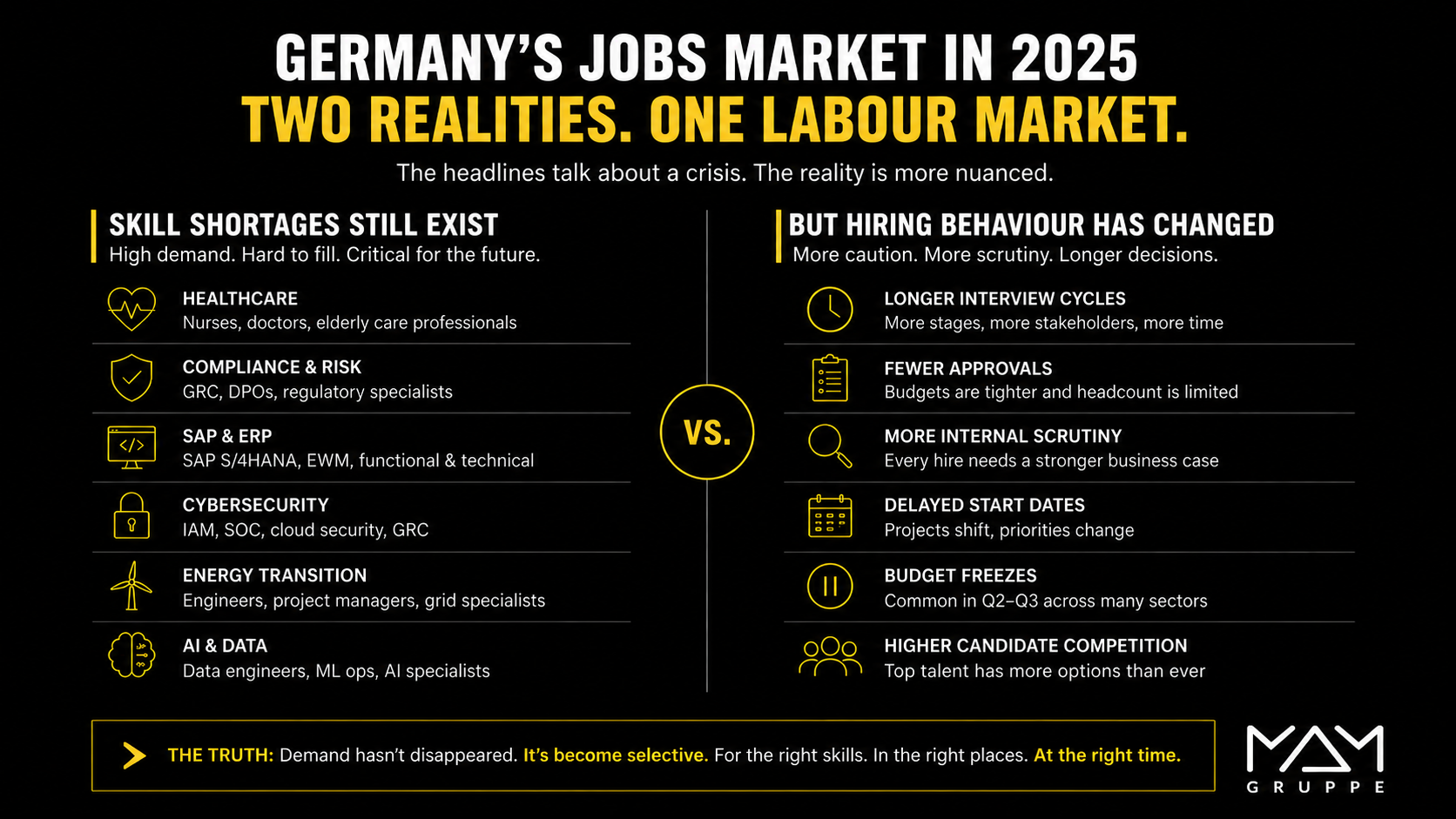
Here's the part that might surprise you. A tighter jobs market for candidates does not automatically make hiring easier for employers.
Yes, there are more people actively looking. Yes, response rates to job postings have improved. But the talent you actually want, the experienced specialist in SAP S/4HANA, the qualified Compliance Officer who knows German regulatory frameworks, the senior Finance Manager with DACH market experience, that person has options. They may be cautious about moving precisely because the market feels uncertain. Or they're being approached by several employers at once, because everyone has worked out that some good people are available.
The mistake to avoid is treating an improved candidate supply as an excuse to slow down your process. In our experience, the employers winning the best hires right now are moving faster, not slower. They're making decisions in days, not weeks. A four-stage interview process with a three-week gap between rounds will still lose you the person you want.
A few things worth thinking about:
Your offer has to make sense. Candidates in Germany have become more financially cautious. A lateral move at a similar salary needs to offer something meaningful: better stability, a clearer growth path, remote flexibility, or a genuinely better working environment. If your offer doesn't have a compelling answer to "why would I take this risk?", expect hesitation.
German-speaking talent remains tight in specific areas. The overall market has softened, but the shortage of bilingual or German-fluent specialists in areas like SAP, Cyber Security, and senior Legal and Compliance has not resolved itself. Candidate supply has improved at the junior and mid level. At the senior and specialist end, you're still competing.
Entry-level hiring is a strategic opportunity. With entry-level job postings running 42 percent below their five-year average according to data from Stepstone.de, genuinely strong junior and mid-level candidates are going unplaced. If your organisation has the infrastructure to develop people, this is a good moment to hire for potential rather than waiting for experience that's already expensive.
Hiring in Germany right now? We work with companies across the DACH region placing specialists in Technology, Legal, Compliance, and Finance. If you're trying to move quickly in a complicated market, we can help. Talk to our team →
What this means if you're looking
The honest message is that the market has shifted, and pretending otherwise won't help you.
If you graduated in the past two or three years, or if you're trying to make a first move into a new sector, you are up against more competition than your peers faced a few years ago. Entry-level applications have increased sharply. Roland Berger's consultancy reports receiving as many as 1,000 internship applications a month, up considerably from before. The people who get interviews are the ones who have done the work to make their application stand out.
For more experienced candidates: the data on mid-career job searches is sobering too. Professionals who assumed their CV would speak for itself are finding the process takes longer and sometimes requires accepting a step sideways or a modest pay reduction to land somewhere good. That doesn't mean you should panic or undersell yourself. It means you should be realistic about timelines and clear about what you actually want from your next role, before you start applying.
A few things that make a practical difference right now:
Be specific about what you're targeting. Applications sent to every relevant-looking job posting tend to produce low response rates. A focused search, fewer applications, better prepared, directed at companies where you can make a genuine case for yourself, tends to work better.
Your German-language profile matters more than many candidates realise. International professionals in particular often have strong English-language CVs and LinkedIn profiles and underdeveloped German ones. In the DACH market, this creates a visibility problem that has nothing to do with your actual qualifications.
A recruiter who knows the market can shorten your timeline. Not because they have a magic list of hidden jobs, but because they know which companies are genuinely hiring, which are saying they're hiring but have frozen headcount, and which roles are worth your time. That intelligence is hard to build on your own from the outside.
Looking for a role in Germany or the DACH region? We place experienced professionals across Technology, Legal, Compliance, and Finance. If you want an honest conversation about what the market looks like for your profile right now, get in touch →.
The bigger picture
Germany's labour market is not in freefall. At four percent by Eurostat's measure, unemployment remains well below the eleven percent recorded at the country's post-unification low point in 2005. The structural argument for skilled worker shortages, driven by an ageing population and decades of underinvestment in vocational training, is still intact. It hasn't disappeared; it's been temporarily overwhelmed by the cyclical slowdown.
The Institute for Employment Research expects unemployment could rise by another 300,000 before conditions stabilise. That means the current period is likely to last at least another year, possibly two.
What that suggests, for both sides of the market, is the same thing: be deliberate, move when the conditions are right, and don't base your decisions on how things worked three years ago. The rules have changed. The people who adjust to that first will come out ahead.